Feed accounts for up to 80% of the total cost of livestock production in Nigeria. That number is not sustainable for most smallholder farmers. Black Soldier Fly farming — using organic waste to produce high-protein larvae — is one of the most promising solutions being adopted across Africa right now, and the economics are remarkable.
The Feed Cost Crisis Driving African Farmers to Insect Protein
Nigeria's livestock farming sector has been under enormous financial pressure since 2022. Poultry grower feed surged by over 270% between 2022 and 2024 alone. For a farmer running 500 broilers, this single cost increase was enough to turn a profitable enterprise into a loss-making one. Across Nigeria, pig farmers, fish farmers and cattle fatteners are facing the same structural challenge — the cost of conventional protein sources like soybean meal and fishmeal keeps rising while market selling prices for livestock products do not rise at the same pace.
The search for alternatives has led a growing number of African agripreneurs and researchers to Black Soldier Fly (BSF) farming — a system that converts organic waste materials into high-protein insect larvae that can replace expensive conventional protein sources in livestock and fish feed.
What Is Black Soldier Fly Farming?
Black Soldier Fly farming is the controlled breeding of Hermetia illucens — the Black Soldier Fly — to harvest its larvae (commonly called BSFL or maggots) as a protein-rich animal feed ingredient. The larvae are exceptional bioconverters: they can consume and convert organic waste — kitchen scraps, market waste, brewery by-products, cassava peels, and agricultural residues — into their own body mass at remarkable efficiency.
The larvae contain 35–45% crude protein and 25–35% fat on a dry matter basis, making them nutritionally comparable to fishmeal — one of the most expensive and increasingly scarce conventional protein sources in livestock feed formulation. Unlike conventional feed ingredients, BSF larvae can be produced continuously on-farm from low-cost or zero-cost organic inputs.
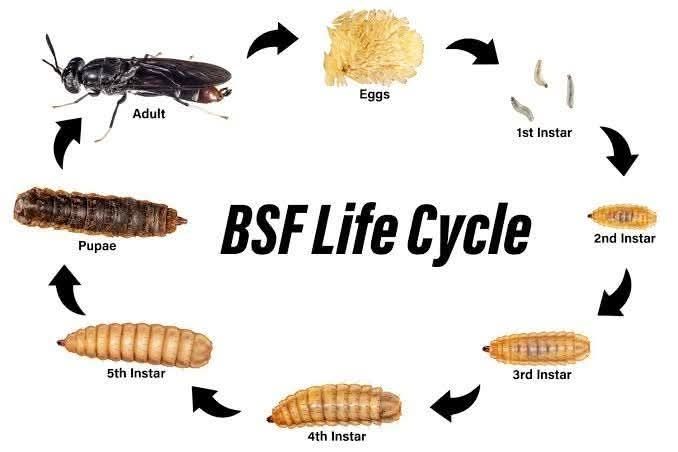
The complete Black Soldier Fly life cycle from adult to egg to five larval instars and pupa. Understanding this cycle is fundamental to managing a BSF farming system effectively.
The BSF Life Cycle: Understanding Your Production System
Successful BSF farming requires understanding the insect's life cycle, which runs from egg to harvestable larvae in approximately 14–21 days under warm tropical conditions — ideal for Nigeria and most of sub-Saharan Africa.
Adult Stage
Adult BSF do not eat during their adult stage — they live only 5–8 days, mating and laying eggs. Adults are attracted to decaying organic matter for egg-laying. A well-managed breeding cage maintains a permanent adult population to ensure continuous egg supply.
Egg Stage
A single female BSF lays between 500 and 900 eggs, which hatch within 4 days. Eggs are typically laid near organic substrates — a piece of wood with small grooves placed near the substrate is a common egg-laying trap used by farmers.
Larval Stage — The Production Stage
This is where the economic value is generated. Larvae pass through five instars (growth stages) over 14–21 days. During the later instars (3rd–5th), larvae enter a feeding frenzy, consuming organic waste rapidly and accumulating protein and fat. This is the harvest window. Smart commercial farmers stagger batches so a new container of larvae reaches harvest stage every day, ensuring a continuous daily supply of fresh larvae.
Prepupal Stage — The Harvest Point
When larvae are ready to pupate, they self-harvest — migrating upward and away from the substrate. Farmers use ramps or tubes that guide prepupae into collection containers. Larvae can then be fed fresh to livestock, dried and milled into meal, or preserved for later use.
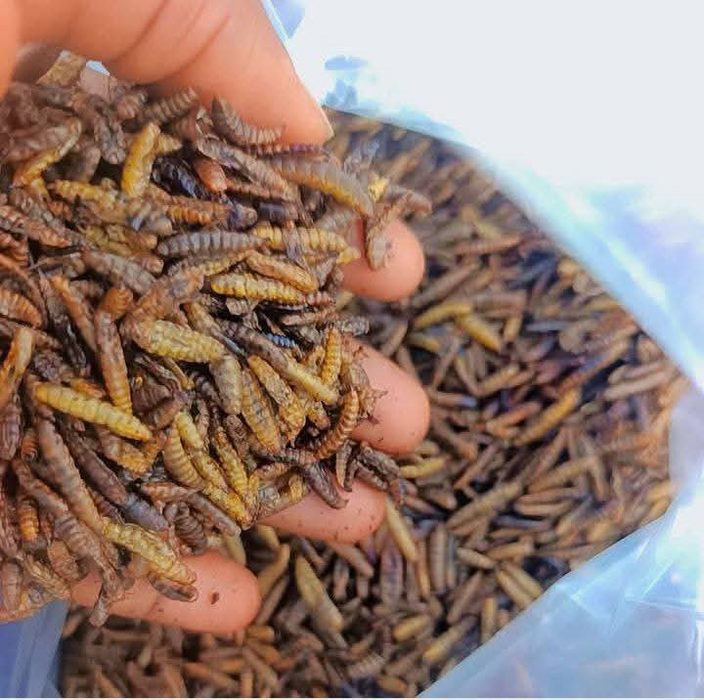
Dried Black Soldier Fly larvae — a high-protein feed product that can replace conventional fishmeal and soybean in livestock and fish feed formulations. Photo: GoOrganicAfrica Research Collection.
The Economics: What Does BSF Farming Actually Save You?
The financial case for BSF farming is compelling. A 2022 analysis published in Agriculture Portal South Africa found that BSF farming can reduce a farmer's total feed bill by up to 60% when larvae replace a significant portion of conventional protein sources. A University of Uganda economic modelling study found that substituting insect-based feed (BSFL meal) for conventional soybean and fishmeal in Uganda would generate net economic benefits of USD 0.73 billion over 20 years, with a benefit-cost ratio of 28:1 and an internal rate of return of 138%.
For individual Nigerian farmers, the numbers are more immediate. A farmer running 500 broilers who replaces 25% of their commercial feed ration with fresh BSF larvae can expect meaningful savings on their monthly feed bill — with the larvae produced from kitchen waste, market scraps or agricultural by-products that cost little or nothing.
The Secondary Revenue Stream: Frass Fertilizer
A significant advantage of BSF farming that many first-time producers overlook is the value of frass — the excrement and residual organic matter left after larvae finish processing the substrate. BSF frass is a highly effective organic fertilizer, rich in nitrogen, phosphorus and potassium, with additional chitin content that supports plant immunity against pathogens. Dried frass sells commercially and provides a second income stream from the same production process.
The BSF Farming Setup: What You Need to Get Started
A basic BSF farming unit requires relatively modest infrastructure:
- Breeding cage: An enclosed space (can be a simple net cage or dedicated room) where adult BSF mate and lay eggs.
- Egg collection substrate/trap: Pieces of wood or cardboard positioned near the organic substrate attract egg-laying adults. The carved wooden egg strip shown in the images above is a practical example of a simple, locally made egg collection tool.
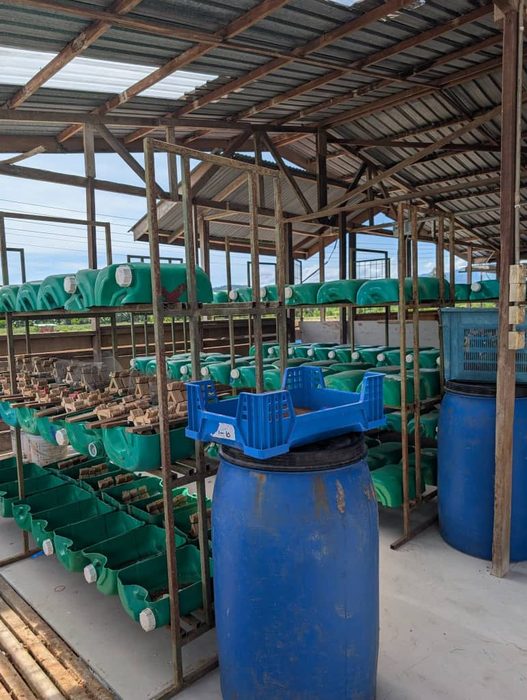
- Feeding containers/trays: Shallow containers where larvae are fed the organic substrate. Can be plastic crates, basins or custom trays.
- Organic waste supply: The input that costs nothing — kitchen scraps, market vegetables, brewery waste, cassava peels, palm kernel meal, fish offal.
- Drying equipment (optional): For commercial operations, a simple solar dryer or oven is used to dry larvae for storage and milling.
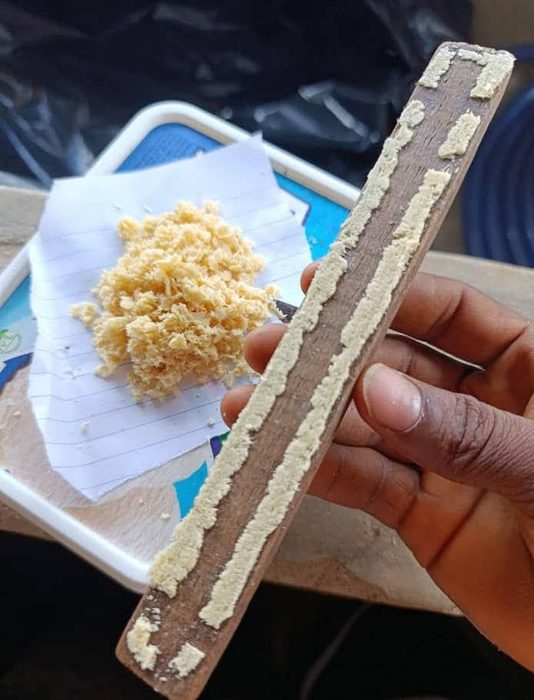
Black Soldier Fly eggs clustered on a wooden egg collection strip — a simple, locally made tool that encourages females to lay in controlled locations for easy collection. Photo: GoOrganicAfrica Research Collection.
Which Livestock Benefit Most From BSF Larvae?
BSF larvae have been successfully incorporated into the diets of multiple livestock classes with documented positive results:
Poultry (Broilers and Layers)
Broilers fed diets containing 25–50% BSFL meal as a fishmeal replacement have shown comparable or improved growth rates compared to conventional feed controls in multiple African research trials. For layers, BSF larvae improve egg production rates, shell quality and yolk colour when fed at appropriate inclusion levels.
Fish (Catfish and Tilapia)
Fish farmers in Nigeria are among the most enthusiastic adopters of BSF as an alternative to expensive omena (silver cyprinid) and imported fishmeal. BSFL protein is highly digestible for both catfish and tilapia and has shown positive results on growth rate and feed conversion efficiency.
Pigs
Pigs readily consume BSF larvae fresh — farmers often allow pigs to self-harvest from larvae bins, combining waste management, protein production and pig feeding into a single integrated system. Inclusion rates of 30–50% BSFL in pig rations have demonstrated positive growth performance outcomes.
The Nigerian and African BSF Farming Story
The story of Nigerian agripreneur Tolu Ajibola, documented by The Junction (March 2025), captures what is possible. After initially struggling with uncontrolled conditions, Ajibola invested in creating a regulated temperature and humidity environment for BSF production and built a feed supply business serving poultry, fish and pig farmers in his region. His experience reflects a broader pattern across Nigeria and West Africa — BSF farming is transitioning from an experimental curiosity to a commercially viable agribusiness.
A 2026 research article published in Frontiers in Environmental Economics found that the actual adoption rate of BSFL in sub-Saharan Africa is still only 4% among surveyed livestock farmers, but awareness is growing rapidly — and the treatment effect analysis found that adoption rates could increase substantially with better farmer education and access to starter colonies. That gap between current adoption and potential adoption represents a significant opportunity for early movers.
Key Takeaways
- BSF larvae contain 35–45% crude protein — comparable to fishmeal — and can be produced from zero-cost organic waste inputs.
- Feed cost reductions of 30–60% have been documented when BSFL replaces conventional protein sources in livestock rations.
- The BSF life cycle produces harvestable larvae in 14–21 days under Nigerian tropical conditions.
- Frass fertilizer provides a second income stream from the same production process.
- BSF farming is applicable to poultry, catfish, tilapia, pigs and other livestock.
- Infrastructure requirements are modest and can be scaled from small to commercial operations.
Frequently Asked Questions
Do BSF smell or attract disease?
A well-managed BSF unit has minimal odour compared to unprocessed organic waste. BSF larvae actually suppress competing fly species (including disease-carrying houseflies) because they produce antimicrobial compounds and outcompete other insects for the organic substrate. Good moisture management keeps odour to a minimum.
Can BSF farming be done indoors?
Yes — and for breeding and egg collection, indoor or semi-covered environments actually produce more consistent results. A cage or enclosed room maintains adult flies and promotes controlled mating and egg-laying. Larval growing bins can be kept indoors or in a shaded outdoor area.
Where do I source my first BSF colony?
In Nigeria, BSF colonies can be sourced from established BSF farmers and research institutions, or attracted naturally — placing organic waste in an outdoor area during warm weather will typically attract wild BSF females for egg-laying within a few weeks. Starting with a purchased colony from a reputable source saves significant time.
How much can one BSF bin produce?
A single well-managed BSF bin (roughly 60 cm × 40 cm) stocked with enough eggs can produce 2–5 kg of fresh larvae over a 14-day cycle, depending on the quality and quantity of organic substrate. Multiple staggered bins in rotation create a continuous daily harvest.
Further Reading and External Resources
For additional research on Black Soldier Fly farming and insect protein in Africa:
- FAO — Edible Insects and Insect Protein: authoritative global research on insect-based livestock feed
- IITA: African agricultural research institution supporting sustainable feed alternatives
Conclusion: BSF Farming Is an Agribusiness, Not Just a Feed Alternative
Black Soldier Fly farming represents something larger than a feed cost reduction strategy. It is a circular economy business model — turning organic waste that would otherwise rot or pollute into high-value protein for the livestock sector, while generating organic fertilizer as a by-product. For Nigerian and African farmers facing the dual pressure of rising feed costs and growing concerns about feed security, BSF farming offers a practical, scalable and increasingly well-documented pathway to lower costs and greater self-sufficiency.
The technology is not experimental anymore. Farmers across Nigeria, Kenya, Ghana, Uganda and South Africa are already running profitable BSF operations. The question is no longer whether it works — it is when you will start.
Get the Complete BSF Farming Guide
Our Black Soldier Fly Farming guide covers the complete production process, feeding rates, equipment setup, and how to build a profitable BSF agribusiness from the ground up.
Get the Complete Guide