If you are a livestock farmer in Nigeria or anywhere in Africa, your single biggest monthly expense is probably feed. Commercial feeds keep rising. Pasture keeps shrinking. And the pressure on your margins keeps growing. Hydroponic fodder farming may be the most practical answer many farmers have yet to try.
Why Feed Costs Are Crushing African Livestock Farmers in 2026
Feed accounts for between 60% and 80% of the total cost of livestock production across sub-Saharan Africa. In Nigeria alone, poultry grower feed prices surged by over 270% between 2022 and 2024, pushing countless small-scale farmers out of business or into heavy losses. Goat, cattle and dairy farmers face the same pressure — traditional grazing land is shrinking as a result of land use changes, and the cost of buying hay or commercial concentrates has made profitability difficult for all but the largest operations.
The challenge is not unique to Nigeria. Across East, West and Southern Africa, millions of livestock farmers are searching for sustainable, low-cost alternatives to conventional feeds. Hydroponic fodder farming has emerged as one of the most compelling solutions — and it is gaining serious traction from Kenya to Cameroon.
What Is Hydroponic Fodder Farming?
Hydroponic fodder farming is the practice of growing fresh, green livestock feed directly from seeds — without soil — using water and controlled conditions. Seeds such as sorghum, wheat, maize or barley are germinated and grown in shallow trays over a period of 4 to 8 days, producing a mat of green shoots, roots and ungerminated seeds that is fed whole to livestock.
The result is a fresh, living feed source that is highly palatable to all classes of livestock — poultry, goats, sheep, cattle, horses and fish — and that retains much of the nutritional value lost during conventional drying, storage and processing of commercial feeds.
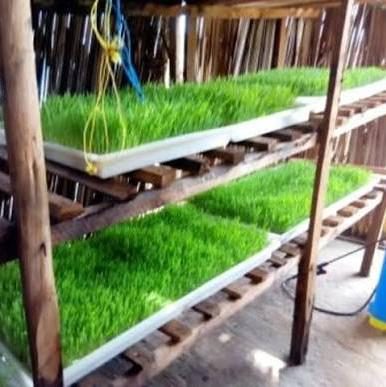
A simple local hydroponic shelf system with growing trays producing fresh green fodder. Photo: GoOrganicAfrica Research Farm, Nigeria.
The Numbers That Make Hydroponic Fodder Compelling
The economics of hydroponic fodder are striking. Research published in Nigeria (Yobe State College of Agriculture, 2024) found that producing 600 kg of maize fodder hydroponically requires only 50 square metres of growing space, compared to a full hectare of farmland using conventional methods. That is a land-use reduction of over 99%.
Beyond space efficiency, the conversion ratio of seed to fodder is the key figure every farmer should understand. Depending on the seed type and management, 1 kg of seed produces between 6 and 8 kg of fresh green fodder within 7 to 8 days. The nutritional profile of the fodder — particularly the protein, fibre and enzyme content — is significantly enhanced during the germination process compared to the raw dry seed.
A 2026 analysis of hydroponic fodder systems in Kenya found that farmers replacing a portion of commercial concentrate with hydroponic fodder were cutting their feed bills by up to 50%, while maintaining or improving animal performance in terms of weight gain, milk production and egg output.
Key Statistics at a Glance
- 1 kg seed → 6–8 kg of fresh fodder in 7–8 days
- 80% less water used compared to conventional pasture growing
- Over 99% less land required per kilogram of fodder produced
- Feed cost reductions of 30–50% reported by farmers using the system as a supplement
- Suitable for: poultry, goats, sheep, cattle, pigs, horses and fish
How a Hydroponic Fodder System Works: From Seed to Feed in 8 Days
The process is simpler than many farmers expect. Here is the production flow:
Day 1 — Seed Selection and Soaking
Select good quality seeds — sorghum, wheat, maize or barley are the most commonly used in Nigeria and West Africa. Clean the seeds thoroughly to remove dust and debris, then soak them in clean water for 8 to 12 hours to initiate germination.
Day 2 — Incubation
After soaking, drain the seeds and spread them evenly in a dark, humid environment for 24 hours to trigger sprouting. Seeds should be kept moist but not waterlogged during this stage.
Days 3–8 — Tray Growing
Transfer the pre-germinated seeds into growing trays and place them on shelf racks inside your hydroponic shelter. Water the trays 2–3 times daily. The trays should have drainage holes to prevent waterlogging, which causes root rot. By day 4–5, visible green shoots appear. By day 6–8, the fodder mat is 15–25 cm tall and ready to harvest.
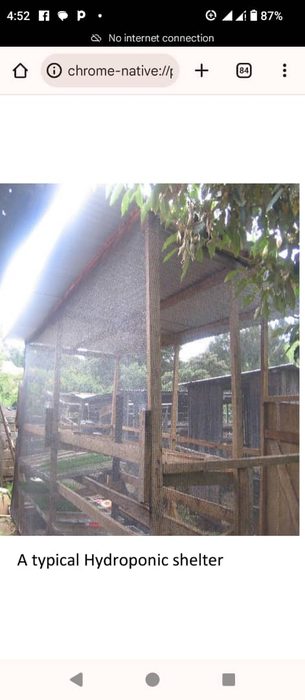
A typical hydroponic shelter using shade netting to regulate temperature and light. Such structures can be built affordably from local materials. Photo: GoOrganicAfrica Research Farm, Nigeria.
Day 8 — Harvest and Feeding
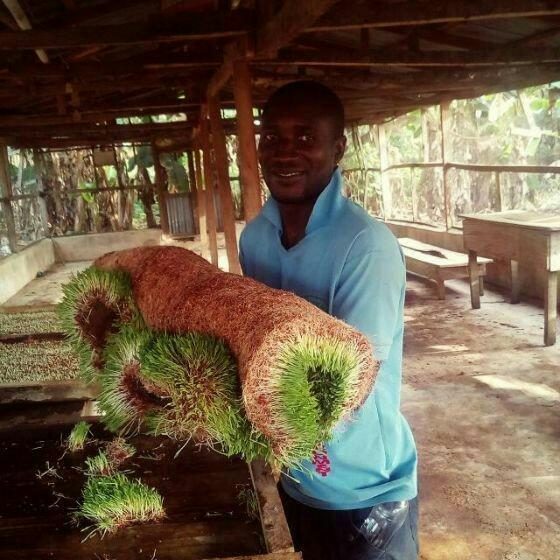
Remove the entire mat from the tray — it peels off in one piece like a carpet. Feed the whole mat to your animals immediately, including roots, ungerminated seeds and shoots. Nothing is wasted. The tray is then rinsed and reused for the next cycle.
What Shelter and Equipment Do You Need?
One of the biggest advantages of hydroponic fodder farming is that it does not require expensive infrastructure. Two approaches work well for African farmers:
The Simple Local Shelter Approach
A basic hydroponic unit can be built from locally available wood, bamboo or iron pipes, with shade netting or tarpaulin for walls and roof. The key requirements are shade (to avoid direct harsh sunlight), ventilation, and a water source. Many small-scale Nigerian farmers start with a 3m × 4m local shelter housing 6–8 shelf racks, each carrying 4–6 trays. This is enough to supplement feed for a flock of 200–500 birds or a small goat/cattle herd.
The Advanced Commercial Shelter
Larger operations use metal-frame structures with shade netting on all sides for better airflow control, and may install a simple drip or mist irrigation system to automate watering. Temperature control is important — the ideal growing temperature is 18°C–28°C. Shade netting helps manage this in tropical climates without the cost of air conditioning.
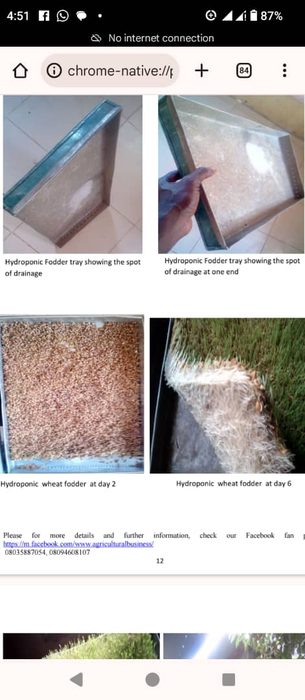
Hydroponic tray drainage design (left) and the visible progression of wheat fodder from day 2 to day 6 (right). Proper drainage prevents root rot. Photo: GoOrganicAfrica Research Farm, Nigeria.
Which Seeds Work Best in Nigeria and West Africa?
Sorghum is the most widely used seed for hydroponic fodder in Nigeria due to its availability, low cost and good yield. It produces a soft, highly palatable fodder that livestock accept readily. Wheat and barley produce higher-protein fodder and are particularly valued for dairy cattle and poultry, but may be harder to source in some regions. Maize is commonly available and produces acceptable fodder, though slightly lower in protein than wheat or barley. For the best results, use clean, untreated seeds with a germination rate above 90%.
Which Animals Benefit Most?
Hydroponic fodder has been successfully fed to virtually all livestock classes. In Nigeria and West Africa, the most common applications are:
- Poultry (layers and broilers): Used as a supplement replacing 10–20% of commercial feed, particularly to improve feathering, egg yolk colour and shell quality in layers.
- Goats and sheep: Fresh fodder is extremely palatable and supports weight gain and milk production in does.
- Cattle: Particularly valuable as a dry-season supplement when pasture quality collapses. Significantly reduces the need for purchased hay.
- Fish: Some catfish and tilapia farmers use ground hydroponic fodder as a partial feed substitute in pond feeding systems.
The Broader African Context: Why This Matters Now
Beyond individual farm economics, hydroponic fodder farming addresses some of the most pressing structural challenges facing African agriculture in 2026. Climate change is making rainfall less predictable, reducing the reliability of conventional pasture. Insecurity in parts of northern Nigeria and the Sahel has forced many herders off traditional grazing routes. Urbanisation is placing farmland under pressure across the continent.
A 2026 Frontier Tech Hub pilot in Nigeria found that hydroponic fodder could serve as a critical buffer for cattle herders who have lost access to traditional grazing land — producing feed close to the animals, with minimal land and water, year-round. This has significant implications for reducing farmer-herder conflicts and improving livestock productivity in areas that have been hardest hit by climate and security pressures.
Key Takeaways
- Hydroponic fodder farming produces fresh green livestock feed in 4–8 days from seed, using up to 80% less water and 99% less land than conventional pasture.
- 1 kg of seed yields 6–8 kg of fresh fodder, making it one of the most efficient feed production methods available to smallholder farmers.
- It is suitable for poultry, goats, sheep, cattle, pigs and fish — and works as a supplement that can reduce feed costs by 30–50%.
- Infrastructure requirements are low — a simple local shelter with wooden shelves and basic trays is enough to get started.
- Sorghum, wheat and maize are the most practical seeds for Nigerian and West African farmers.
- The technology is gaining significant research and investment support across Africa as a climate-smart, low-cost feed solution.
Frequently Asked Questions
Can hydroponic fodder completely replace commercial feed?
No — and it is important to understand this clearly. Hydroponic fodder works best as a supplement, replacing 15–30% of the total ration depending on the animal class. It significantly reduces the cost and improves the freshness and palatability of the overall diet, but balanced nutrition still requires other feed components, particularly protein concentrates for high-producing animals.
How much space do I need to start?
A very small-scale system can start in as little as 6–10 square metres of sheltered space. Scaling up is straightforward — each additional shelf rack adds more daily fodder output without significant infrastructure cost.
What is the most common mistake beginners make?
Overwatering is the most common failure point. Trays must drain freely — if water sits in the tray, roots rot within 24–48 hours. Ensure your trays have adequate drainage holes and that the shelf is slightly tilted to allow runoff.
Where can I learn more about the practical production steps?
Our Hydroponic Fodder Farming Guide covers the full step-by-step production process including tray dimensions, seed quantities, watering schedules, feeding ratios for different livestock, and how to calculate your cost savings. View the complete guide here.
Further Reading and External Resources
For additional research on hydroponic fodder farming in Africa, the following authoritative sources provide supporting data:
- FAO — Food and Agriculture Organization: global data on livestock feed costs and smallholder farming in sub-Saharan Africa
- IITA — International Institute of Tropical Agriculture: research on livestock and feed production across West Africa
Conclusion and Future Outlook
Hydroponic fodder farming is not a trend — it is a practical, farm-tested technology that is already helping livestock farmers across Nigeria, Kenya, Ghana and beyond reduce their feed costs and maintain production during difficult economic conditions. The combination of rapid growth cycles, minimal land requirements, low water use and universal livestock acceptance makes it one of the most compelling tools available to African farmers right now.
As feed prices continue to rise and climate pressure on pasture increases, the farmers who adopt hydroponic fodder systems today are positioning themselves for significantly lower production costs and greater resilience over the coming years.
Ready to Get the Complete Step-by-Step Guide?
Our Hydroponic Fodder Farming Guide covers every detail of the production process, feeding ratios, and how to calculate your savings — written from real farm experience in Nigeria.
Get the Complete Guide